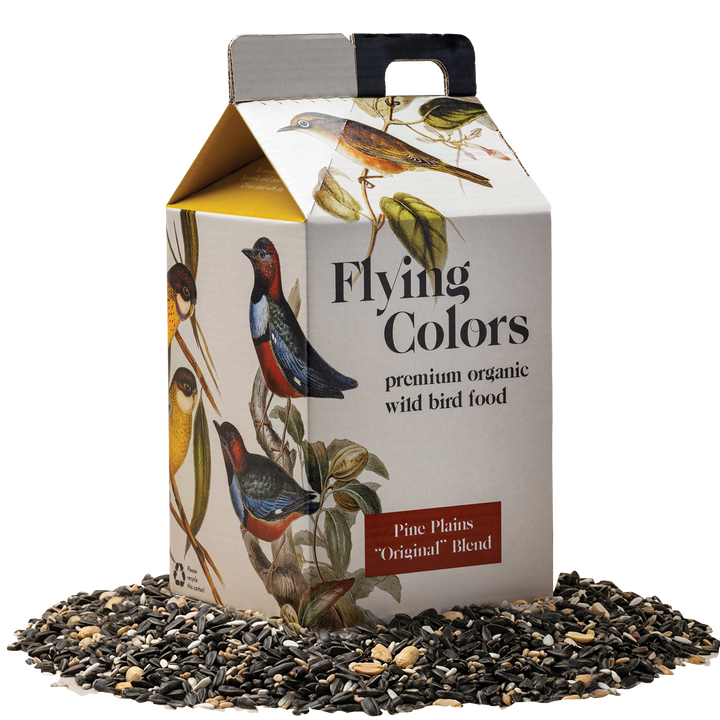
Pine Plains “Original” Blend

THE SCIENCE

Nutrition research, translated to the feeder

Most bird seed is designed for shelves, not birds. Flying Colors is different. Our blends were developed with scientists who study the biochemistry of migratory flight, the nutritional needs of wild songbirds, and the habitat ecology of farmland birds. 

The research

What the science shows

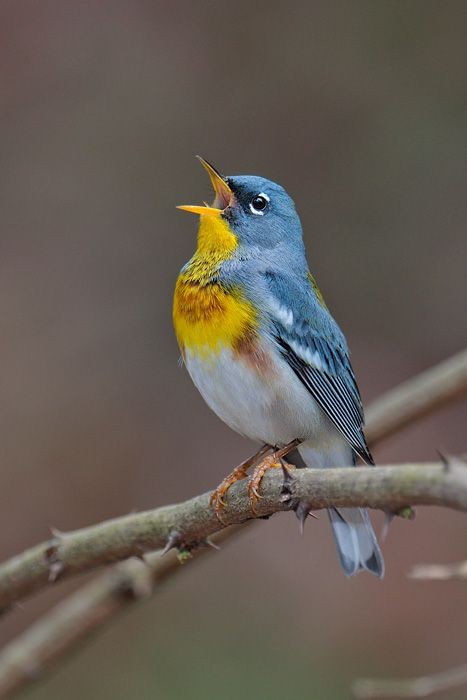
Wild bird studied in Flying Colors nutrition research

Decades of research have established that what birds eat determines how well they fly, how quickly they recover from migration, and how resilient they are to environmental stress. Flying Colors was built on these findings.

Fatty Acids & Flight Performance

URI research demonstrates that dietary polyunsaturated fatty acids measurably improve aerobic efficiency during endurance flight.

Antioxidants & Oxidative Stress

Long-distance migration generates significant oxidative stress.

Seasonal Field Monitoring

Our teams long-term monitoring of our feeders reveals which seed types birds actually select across seasons, not just peak activity, but migration, wintering, and nesting.

Zoological Nutrition Standards

Kurt Hundgen's work at the National Aviary brings a whole-bird perspective that goes far beyond standard backyard feeding convention.

Nutritional Modeling

Blend ratios emerged from models built from published data on avian metabolic requirements, the same approach used to formulate diets for rare species in zoological collections.

No Filler. No Compromise.

Cheap blends use fillers like milo, red millet and corn, ingredients birds largely ignore and that end up as waste.

The science

Why organic matters

Conventional bird seed can carry pesticide residue that does not stay put. Here is what happens once it reaches a feeder.

Pesticides build up in small bodies

Songbirds and backyard birds are tiny compared to the animals most pesticide safety limits are built around. Residue that looks like a trace amount to a regulator can accumulate fast in a bird's system, weakening feathers, hearts, and immune systems over time.

Treated seed can poison instead of nourish

Seed coated in agricultural chemicals does not tell the difference between a pest and a wild bird. For migrating and nesting birds, a single exposure can be enough to disrupt a migration pattern or a nesting cycle, not just spoil a meal.

Fillers offer no nutrition, and birds know it

Cheap fillers like dyed grain and corn add bulk, not nutrition, and can disrupt digestion. Wild birds sort through it and leave the rest, so a feeder that looks full is often mostly waste.

What is sprayed on the field ends up in the yard

Residue does not stay on the seed. It moves through droppings, feeders, and soil, then back into the yard where birds return to feed. Organic sourcing is the only guarantee of safety at every step.

Songbird declines are not just about habitat

Backyard bird populations have fallen for decades. Habitat loss gets most of the attention, but contaminated food is a compounding factor, and it is one that a bag of organic seed can actually help fix.

Shop organic seed
Wild bird feeding on Flying Colors organic seed

Reviewed by our ornithology advisory board

Our scientific advisory board

The flock behind the seed

We've assembled a team of leading ornithologists and conservation scientists with expertise spanning migratory physiology, farmland bird ecology, and zoological animal care. We work with them to translate cutting-edge research directly into product development.

Wild bird feeding on Flying Colors organic seed

Research from the University of Rhode Island's Avian Ecology Program has shown that dietary fatty acids, antioxidants, and specific nutrient ratios directly affect a bird's ability to complete migration, maintain oxidative balance during flight, and fuel recovery at stopover sites.

Flying Colors Seed brings this laboratory and field knowledge directly to backyard birders, a blend calibrated to real avian nutritional requirements and refined through the kind of rigorous thinking that produces peer-reviewed science.

Metabolic precision

Fatty acid profiles and antioxidant content are calibrated based on published research on migratory songbird physiology and endurance flight.

Conservation grounded

Formulated with input from professionals actively working to protect threatened species and restore wild populations globally.

Farmland ecology

Seed variety selection informed by long-term monitoring of which seeds birds actually use across habitat types and seasons.

Supply chain integrity

Grown and sourced with sustainability in mind, supporting organic seed growers and regenerative agricultural practices.

Shop organic seed
Did you know?

One seed.
One dead songbird.

That is not a metaphor. A single insecticide-coated seed carries enough neurotoxin to kill a bird the size of a blue jay. Here is what the research shows, in pictures.

This is our why. Follow along.

What happens to the bird

Scientists dosed a wild sparrow. Then they tracked what happened.

That is not a metaphor. A single insecticide-coated seed carries enough neurotoxin to kill a bird the size of a blue jay. Here is what the research shows, in pictures.

01 One seed kills a songbird
Lethal dose
0 seed
Coated seed is enough to kill a songbird

Neonicotinoids are the most widely used insecticides on earth. They are applied as a coating to corn, soy, wheat and sunflower seed before planting. A bird that finds one on the ground has found a lethal dose (American Bird Conservancy, 2013.)

Why this matters

Not sick. Not weakened. Dead, from one seed smaller than a grain of rice. There is no safe amount.

Seeds it takes to kill one bird
One is enough Margin for error: none
02 Survivors stop eating
Appetite shuts down
0
Of its body weight, gone in six hours

Sparrows given a much smaller dose, about a tenth of one seed, quit eating almost immediately. Six hours later they had burned through six percent of themselves. Eng, Stutchbury & Morrissey. Science, 2019.

Why this matters

On a 170 pound person that is losing ten pounds between breakfast and dinner. A bird that weighs less than a slice of bread has nothing in reserve to lose.

Body weight after six hours
Untouched bird
100%
After one dose
0%

The dose was the amount a bird would realistically run into outdoors. It did not have to eat a whole seed.

03 Spring migration is delayed
Grounded, days lost
0 days
Grounded, unable to fly on

Too weak to continue, the dosed birds sat on the ground for three and a half extra days before they could resume their trip north.

Why this matters

Arriving late means the good nesting spots are taken and the caterpillars its chicks eat have already come and gone. It misses its shot at raising a family that year. Most small songbirds only get one or two shots in a lifetime.

Leaving the rest stop
Untouched bird On time
After one dose 3.5 days late
04 Their food supply vanishes
Food supply wiped out
0
Of our land birds feed insects to their chicks

These chemicals soak into soil and water and stay there. They kill insects for years after a single planting, across whole landscapes.

Why this matters

A bird never has to touch a treated seed to be harmed by one. It only has to raise a family in a season where there are no caterpillars left to find.

Every bird here is 1% of our land birds
Needs insects to feed its young Does not
05 The losses add up
Birds already lost
0 billion
Gone from North America in the last years

More than one in four birds, vanished since 1970. That is years, well inside one human lifetime. Pesticides are one of the causes scientists name, along with habitat loss. Rosenberg et al. Science, 2019.

Why this matters

If you were born before 1970, roughly a third of the birds you grew up hearing are not out there anymore. That is the sound your backyard is missing.

Out of every 100 birds alive in 1970
Lost since 1970 Still here
References

Where these numbers come from

American Bird Conservancy, 2013.The Impact of the Nation's Most Widely Used Insecticides on Birds. A single treated seed is enough to kill a songbird.

Eng, Stutchbury & Morrissey. Science, 2019.A neonicotinoid insecticide reduces fueling and delays migration in songbirds. Six percent body mass lost in six hours; 3.5 day median delay in departure.

Eng, Stutchbury & Morrissey. Scientific Reports, 2017.Imidacloprid and chlorpyrifos impair migratory ability in a seed-eating songbird.

Rosenberg et al. Science, 2019.Decline of the North American avifauna. Net loss of roughly three billion birds since 1970.

American Bird Conservancy.Neonicotinoid dossier, abcbirds.org/neonics. 96 percent of North American land birds rely on insects.

Cornell Lab of Ornithology.Neonic pesticides interfere with sparrow migration, studies show. All About Birds.

Weidensaul, S. LivingBird, 2022.Neonic Nation: is widespread pesticide use connected to grassland bird declines?

Horn, Johansen & Wilcoxen. Wildlife Society Bulletin, 2014.Seed and feeder use by birds in the United States and Canada.

What's inside

Meet the ingredients

Six ingredients. Nothing else. Every seed in a Flying Colors blend earns its place, chosen for what it gives birds, and for what it never leaves on the ground. Tap any ingredient for its story and sourcing.

Botanical photography to come

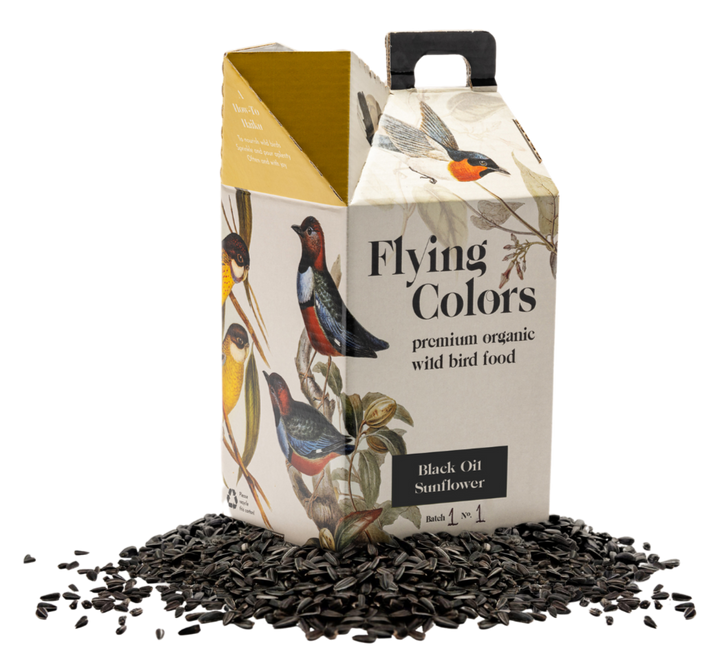
Black Oil Sunflower

The backbone of every feeder. The highest fat density of any seed we carry, with a shell thin enough that nearly any bird can crack it open.

Attracts
CardinalsChickadeesFinchesNuthatches
Highest FatSoft ShellLoved by All
View details +
Botanical photography to come

Sunflower Hearts

Sunflower with the shell already removed. Pure kernel, so there's nothing to sweep and nothing wasted. Perfect over patios, decks, and lawns.

Attracts
CardinalsFinchesChickadeesSparrows
Hull-FreeZero MessHigh Protein
View details +
Botanical photography to come

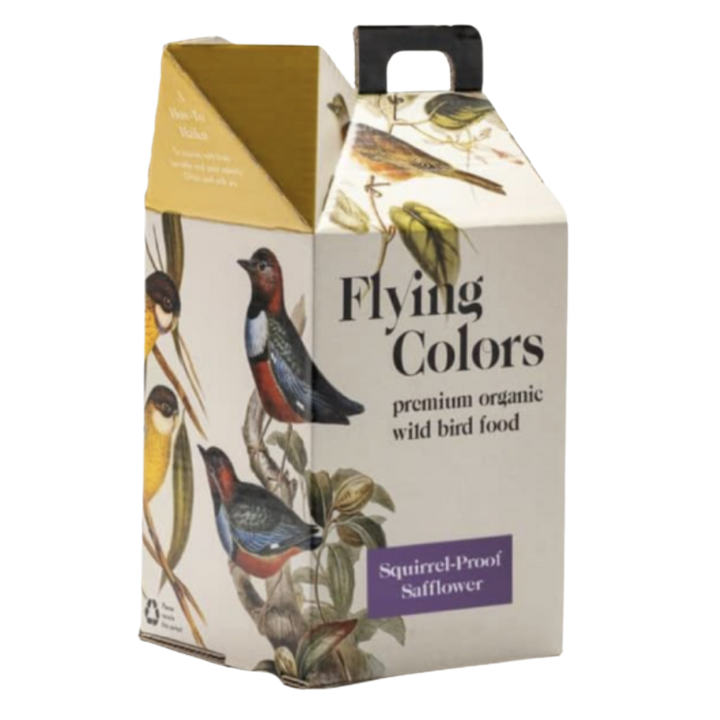
Safflower

A small white seed squirrels find too bitter to bother with, but cardinals adore. Quiet at the feeder, by design, with zero fillers to hide behind.

Attracts
CardinalsChickadeesDovesGrosbeaks
Squirrel-ResistantCardinal FavoriteNaturally Bitter
View details +
Botanical photography to come

Peanut Hearts

Dense protein and fat that carries birds through the coldest snaps. An irresistible draw for clinging birds and the bold jays that raid in daylight.

Attracts
WoodpeckersNuthatchesTitmiceJays
High ProteinHigh EnergyWinter Fuel
View details +
Botanical photography to come

Millet Hearts

A tiny, tender seed for the ground-feeding crowd. The sparrows, juncos, and doves that prefer to dine below the feeder rather than perch above it.

Attracts
SparrowsJuncosDovesBuntings
Ground FeedersSmall-BeakGentle
View details +
Botanical photography to come

Hemp

Rich in the omega-3 and omega-6 fatty acids that fuel migratory flight, per URI research. The reason Woodstock is our most complex, most nourishing blend.

Attracts
FinchesSiskinsRedpollsBuntings
Omega-3Omega-6Migration Fuel
View details +